|
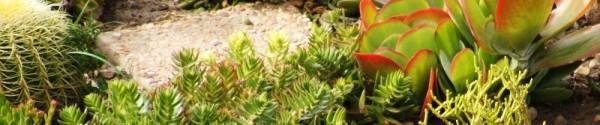
SUCCULENTS
On the premises of Eden@Astonbay as
well as the adjacent premises of the Gibson’s, the owners, you can view a very
extensive collection of weird and wonderful succulent plants and if you like you
can even buy a surplus “plant pet” for a keep sake.
In their book Succulents of South Africa a guide to the regional diversity,
Ernst van Jaarsveldt, Ben-Erik van Wyk, and Gideon Smith (2002) said that
Succulents are found in semiarid and arid regions throughout the New and Old
worlds . Africa and its associated islands have some of the world’s richest
plant centres, notably South Africa, the Rift Valley in eastern Africa, the horn
of Africa (in North East Africa), Madagascar, and the canary islands, as does
the Yemen Republic in adjacent Arabia.
Diversity is further by physical features (mountain ranges) and geological
complexity, resulting in local dry sites and a variety of soil types. As result,
the fragmentation of plant populations is promoted. Perhaps the most important
reason for South Africa’s high succulent plant diversity is the seasonality of
rainfall. It is not only the occurrence of winter rainfall along the west coast
that has contributed to the diversity of succulents, but also the regularity and
predictability of these rains.
Growth of succulents in the winter-rainfall Karoo regions coincides with the wet
season (May to September). During this period, evaporation is low and frosts are
uncommon or mild. Most succulents from this region rest during the dry summer
months, surviving on the moisture taken up and stored during the preceding
winter months. In contrast, succulents from the summer-rainfall Karoo regions
(the Great Karoo and Upper Karoo) grow during the wet summer months (September
to April). The intensity of the rainfall causes rapid runoff and high rates of
evaporation.
Ernst van Jaarsveldt and Daryl Koutnik in their remarkable book, Cotyledon and
Tylecodon (2004), say that the family Crassulaceae (crassus means fat) in the
world’s third largest succulent family ( the Cactaceae and Aizoaceae being
larger), and many members of the family are commonly grown as garden and
container plants (indoors and outdoors) all over the world. The largest
concentration of species is in South Africa and the two genera Tylecodon and
Cotyledon treated here are horticulturally well known, especially Cotyledon.
The writers also give us more very interesting facts about the the distribution
of succulents in the attached schematic which highlights the importance of South
Africa as a succulent “heritage” location.
Futhermore they say that the family Crassulaceae are dicotyledonous plants
belonging to the order Rosales. It is essentially a cosmopolitan family but is
absent from Australia and much of South America. The family consists of ± 1500
species. The genus Sedum is the largest in the family Crassulaceae with some 428
species. One of the main centres of distribution is in the dry, karroid,
winter-rainfall regions of southern Africa. Five genera are represented in
southern Africa: Adromischus, Cotyledon, Crassula, Kalanchoe and Tylecodon.
Crassula is the largest genus with about 150 species.

Click on pictures to
enlarge
Contact us for more info
|
|